Why You Can’t Vibe Code a Marketing Compliance Tool
austin carrollVibe coding has changed how fast teams can build. You describe what you want in plain English, an AI writes the code, and shortly after you have a working app. Plenty of marketing and compliance teams have watched this happen and thought the obvious thing: could we build our own ad review tool this way?
The honest answer is that you can maybe build a good enough demo. What you cannot build over a weekend or even a couple months is the thing a bank, credit union, insurer, or fintech is actually buying when it licenses a compliance platform.
What Vibe Coding Does
Here is what a vibe-coded compliance demo usually looks like. Someone writes a script that takes ad copy, sends it to a large language model, and asks it to flag anything that might violate advertising rules. Paste in “Guaranteed approval, no credit check!” and it lights up. Paste in a clean headline and it gives a thumbs up. The first demo feels like progress.
The trouble starts when a regulated institution has to depend on that demo. Detecting a risky phrase is one skill. Running a marketing compliance program that stands up to an examiner is a different job entirely, and it rests on a maintained rule library, an audit trail, independent accountability, and several operational requirements covered below.
Pillar 1: The Library
A tool is only as good as the rules behind it
The rules for financial marketing never sit still. One ad can fall under Regulation Z, Regulation DD, UDAAP, FINRA Rule 2210, the SEC Marketing Rule, NCUA and FDIC advertising requirements, and a patchwork of state rules, while new guidance and enforcement actions keep changing how each one is read.
What a real library contains
A regulation is written for lawyers. A tool needs checks it can run the same way every time, so a real library turns each rule into defined triggers and a severity level. Regulation Z shows why. If a closed-end credit ad states a payment amount, the number of payments, a down payment, or a finance charge, it triggers extra disclosures, including the APR. Someone still has to decide what counts as a stated payment in a video caption or a carousel slide, and how close the disclosure has to sit.
A usable library has several layers:
Regulations. Federal, state, and platform rules from many regulators, each with its triggers and a severity rating.
Your own policies. Company rules that sit on top of the regulations and are often stricter.
Brand guidelines. Fonts, colors, trademarks, and tone, checked in the same pass as the legal review.
Approved disclosures. Your exact approved wording, with full and short versions per channel and rules for where each must appear.
Fact records. The proof behind rates, offers, and testimonials.
Tuning matters as much as coverage. A credit union does not need insurance rules, and a social post does not need the same checks as a mortgage brochure. A dedicated tool lets you select the regulations that apply to your sector and products, add your own policies, brand guidelines, and disclosures, and give feedback on what is relevant for different kinds of assets, so results get sharper for your firm over time. A prompt in a script has none of those controls.
What happens when something changes
When a rule, guidance, or enforcement priority shifts, a maintained library follows this loop:
Someone catches the change, often before it makes headlines.
Someone with regulatory knowledge interprets what it means for advertising.
The interpretation becomes a testable policy with clear pass and fail conditions.
The policy is tested against known examples so the update does not break existing checks.
The updated policy goes out to every reviewer at the same time.
Live assets that were already approved get rechecked against the new rule.
Step six is the one people forget. An ad that was compliant on Monday can become a problem on Friday without a single word changing.
An in-house tool relies on one person remembering to run this loop forever. When that person changes roles, updates stop and nobody notices until an examiner does.
A raw model has its own gap. Its training data is already out of date, and it knows nothing about your institution’s internal policies, which are often stricter than the law.
A dedicated platform maintains the library centrally, so a rule update applies to every future scan, and each scan is logged against the rules that were in force at the time. That log is what connects the library to the audit trail in the next section.
Pillar 2: The Audit Trail
Showing a regulator what you check for, and that it works
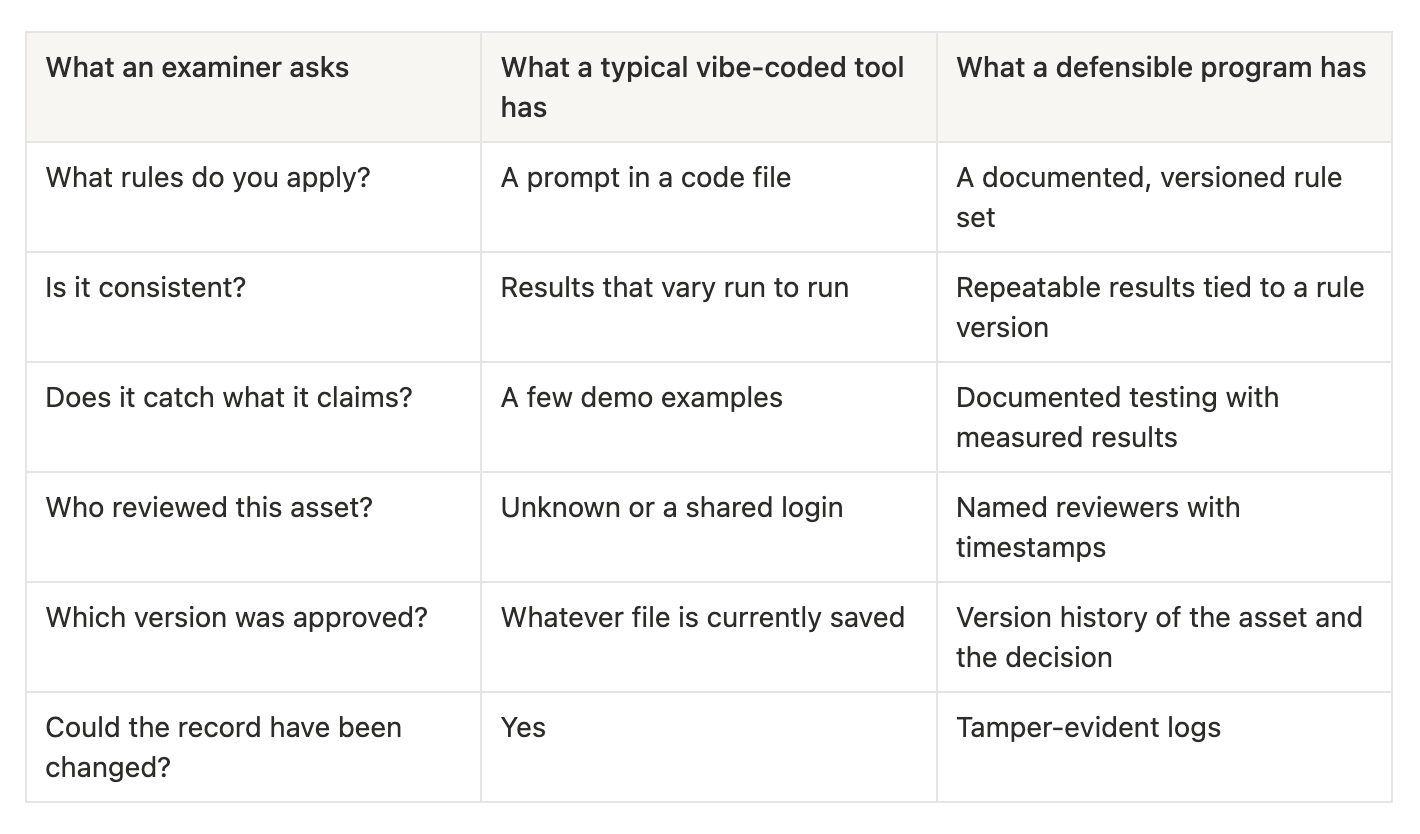
Examiners do not only want to hear that you review your marketing. They want to see the rules that were applied, who reviewed each piece, which version of the asset was approved, and the record behind each decision.
A vibe-coded tool usually cannot produce any of that.
No documented rule set. The “rules” live inside a prompt, and prompts get edited casually, with no version history and no approval step.
No consistent output. Language models can give different answers to the same input on different runs. Providers also update models, sometimes without the user doing anything. Run the same ad today and next quarter and the verdict can change, and you cannot reproduce a decision from fourteen months ago because you cannot say which rules and which model produced it.
No evidence that it works. A tool that claims to catch violations needs documented testing: a set of known good and bad examples, measured results, and a record of how often it misses a real problem. A demo has a few screenshots.
No proof the output was not altered. If anyone with database access can change a result after the fact, the record has little value. Strong audit trails are tamper evident, with a clear history of who did what and when. Firms under recordkeeping rules such as SEC Rule 17a-4 already know that records have to be reproducible and show they were not altered.
The access problem
There is one more uncomfortable scenario. If your only evidence that the tool works is the tool itself, you may end up giving regulators access to your own AI systems so they can watch it run. That exposes your prompts, your data, and your infrastructure, and the answers they see may still differ from the ones they saw yesterday.
A proper audit trail makes that unnecessary. The record answers the questions without anyone having to open the machine.
Pillar 3: Accountability
Who validated it
If the checks come from a tool built in-house, they carry little credibility with an examiner, a model risk team, or vendor management. This is not a matter of the builder’s talent. It is a matter of structure.
Banks and credit unions manage models under frameworks like the Federal Reserve and OCC’s SR 11-7 guidance on model risk management, which expects independent validation and what it calls effective challenge. Third-party tools face vendor due diligence under interagency third-party risk guidance, and security teams typically ask for independent attestations such as SOC 2 reports. A tool someone built over a few weekends has none of this behind it.
Insurers face a similar expectation. The NAIC’s Model Bulletin on the Use of Artificial Intelligence Systems by Insurers tells carriers to maintain a written AI Systems Program and reminds them that decisions made or supported by AI must still comply with existing insurance law, including unfair trade practice rules. It also lists the documentation a state insurance department may request during an examination. According to the NAIC’s adoption tracker, more than two dozen states, plus Washington, D.C. and Puerto Rico, had adopted it as of November 2026. The same questions an examiner would ask about a vendor tool apply to a tool you built yourself, and the records have to exist before the request arrives.
Why independence is the whole point
The same principle explains why auditors come from outside the company. Independence is what makes an audit worth anything.
A tool you built to grade your own marketing is the compliance equivalent of auditing yourself. It is actually less effective than self-auditing, because a human who audits their own work at least leaves a trail of judgment calls. With an in-house tool, there is nothing stopping anyone from adjusting the prompt, the threshold, or the stored result until the report looks right. Even when nobody does that, an examiner cannot confirm they did not.
There is also a plainer question of ownership. When a complaint arrives about an ad the tool passed, who is responsible for the tool’s decision? With an independent, maintained platform, there are named owners, a support process, and a track record. With a weekend project, there is a Slack message to someone who may have moved on.
Hidden Costs the Demo Never Shows
Beyond the core requirements above, several practical gaps tend to surface once a vibe-coded tool meets real marketing operations.
Marketing is more than text. Regulations care about how and where a disclosure appears. A rate in a headline with the required disclosure in tiny gray type at the bottom of an image may not meet the clear and conspicuous standard, and a script that sends plain text to a model cannot see it. Real programs have to cover images, video, captions, landing pages, and social posts, in the form the customer actually sees.
Approved assets change after approval. Landing pages get edited, rates get updated, and ads get tweaked in the ad platform. Ongoing monitoring of live assets is what catches the drift, and a one-time scan does not.
Workflow is half the product. Real review involves routing to the right person, separate roles for creators and reviewers, redlines, version control, and sign-in controls. Each of those is a feature someone has to build and maintain.
Unreleased campaigns are sensitive data. Sending draft ad copy, offers, and sometimes customer details to a third-party model raises vendor contract, retention, and privacy questions that security teams will want answered in writing.
Accuracy has two sides. A tool that misses real violations is a risk. A tool that flags everything wears out its reviewers until they stop reading the flags. Tuning that balance takes testing data and ongoing measurement.
Prompt and model changes need change control. Editing a prompt, switching to a newer model, or adjusting a threshold changes what the tool flags. In a regulated program each of those is a change that needs testing against known examples, an approval, and a dated record. Without that, a tool can quietly get better at some checks and worse at others, and nobody can say when it happened.
Examiners ask why, not only what. A flag that says “possible violation” gives a reviewer little to act on. A defensible result names the rule, the exact text or visual element that triggered it, and the reasoning, so a reviewer can agree or disagree and the decision can be explained later.
Rules differ by state, product, and channel. The same offer can face different requirements depending on the state where it runs, whether it is a loan or a deposit account, and whether it appears in a social post or a mailer. A tool has to know which rule set applies to which asset, and keep those mappings current.
The cost math changes. Engineering time, regulatory research, maintenance, testing, and security review add up quickly. The weekend build often looks cheap only because those costs are invisible at the start.
A Quick Self-Check Before You Build
If you are weighing a build versus a platform, try answering these honestly.
Who will track regulatory changes across every rule we advertise under, and what happens when they are out sick or leave?
How will we turn a change into a tested policy and recheck assets that are already live?
Can we reproduce the exact rules and model behind a decision from last year?
What evidence shows the tool catches what it claims to catch, and misses what rate?
How would we prove to an examiner that a stored result was not edited?
Who outside our team has validated the tool, and would our model risk and vendor management teams accept it?
Does it cover images, video, and landing pages, or only text?
If several of these draw a long pause, that is useful information.
The Bottom Line
A vibe-coded tool can flag a risky headline. A compliance program has to show a regulator the rules, the proof, and the independence behind every decision. That takes a well maintained library, an audit trail that holds up without opening the system, and accountability that comes from outside the team grading its own work.
That is the gap Warrant is built to fill for regulated marketing teams. If you want to see what a maintained library, a clean audit trail, and independent accountability look like in practice, we would love to show you.