Why we built Fact Libraries @ Warrant
Austin CarrollI've been the person searching a shared drive for the old rate. More than once.
Before Warrant, I ran banking marketing at Brex. We marketed a yield product while the Fed raised rates 7 times in 2022. Every move meant our rate changed, and every change kicked off the same fire drill:
Update the homepage.
The pricing page footnote with the "as of" date.
The nurture emails.
The partner pages we didn't control.
The sales deck.
And the one-pager a rep saved to their desktop in March and kept sending for months, because of course they did.
Testimonials were their own adventure. We kept a separate Excel file just to track them: who said it, when they approved it, what we could use it for and when that permission ran out. It lived on a desktop. The files that used the quotes lived somewhere else. So every time a consent lapsed, the question was the same: where did we use that quote?
Nobody was careless. The team was great. Every file was right the day it was approved. The problem was that nothing connected the facts to the places they lived.
I thought it was a Brex problem. It wasn't.
When I started Warrant, I assumed the hard part of marketing compliance was the review itself. Too many files, too few reviewers, a queue that never ends. That's real, and it's what we built first in 2024.
But once we were in the room with customers, the same thing kept coming up. Someone would share their screen and open a spreadsheet.
A wealth manager showed us how they check fund PDFs against the studies behind their claims. By hand. Page by page.
A credit union walked us through their promotions page: sweepstakes, Skip-A-Pay, variable rates. Every one of those has a start date, an end date and a set of rules. Every one of them ends up in a dozen files.
A large bank told us their disclosure sources were scattered across teams, so reviewers checked against whichever version they could find.
Different institutions, same spreadsheet. Every compliance team already has a library. It's just lives in 40 places and kept separate from the live campaigns, webpages and more.
The walls and what moves inside them
Here's how I think about it now.
Your policies are the walls. Fair lending. UDAAP. The FTC rules. The SEC Marketing Rule. They're solid, and they don't change much. Warrant has always been good at checking content against the walls.
But inside those walls, everything changes.
Rates change.
Promotions start and end.
Consents expire.
The award behind your "best in the state" claim gets a year older.
Partners renew and change their logo rules.
Those facts cause most of the returned assets I've seen, and they were the part no tool was keeping track of.
Regulators don't grade on the approval date. They care what the ad says today. So it better be accurate.
What we built
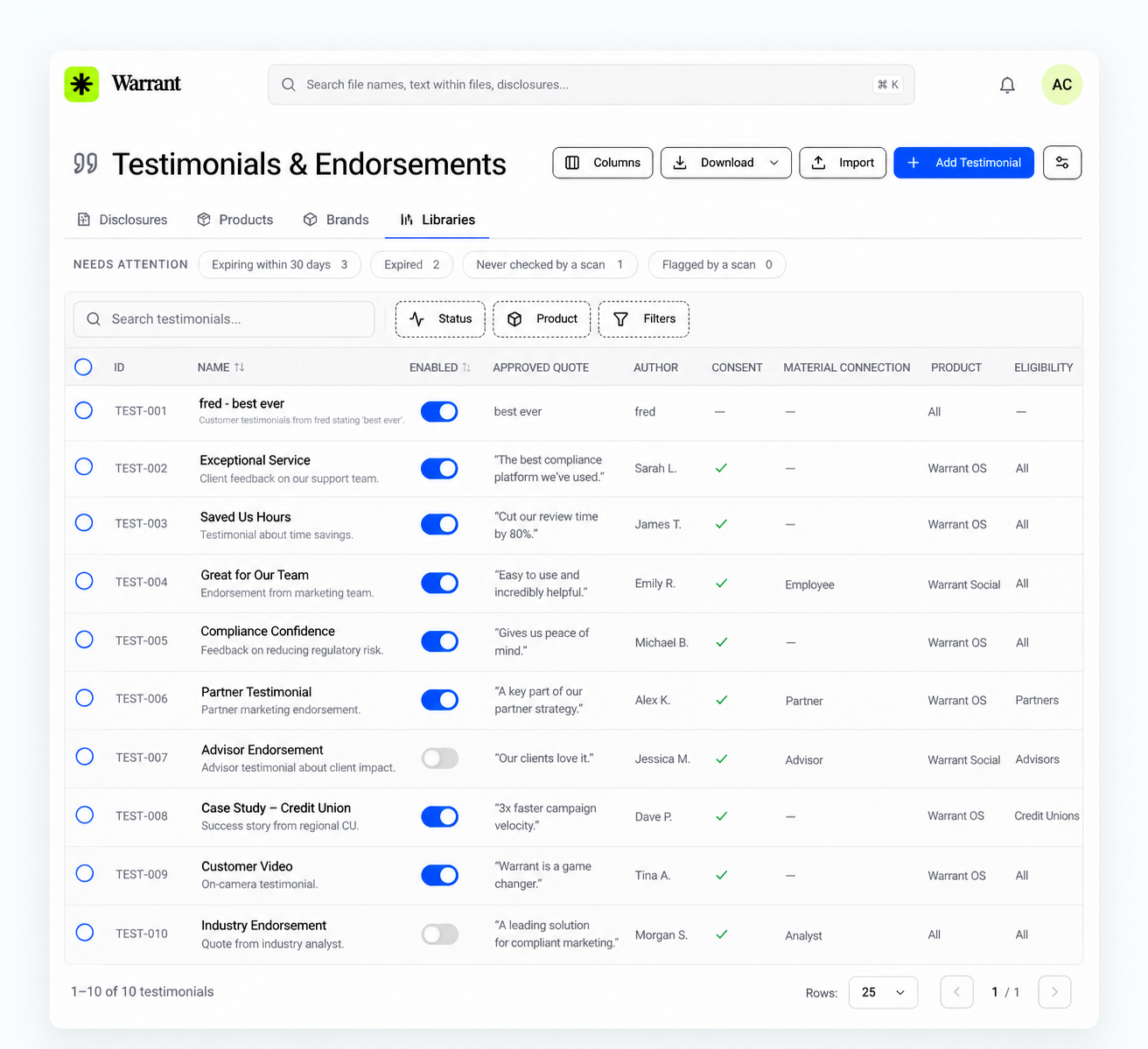
Fact Libraries are the answer I wanted at Brex. The goal is simple: get marketers out of the sheets. Excel, Google Sheets, all of them.
You upload the spreadsheets and files you already keep: rate sheets, promotions, testimonial trackers, award letters, partner brand guidelines.
Warrant checks every future campaign against them. When a claim checks out, the proof stays attached to the file. When a record changes, every file that uses it surfaces on its own.
And it all sits inside the same audit trail as everything else in Warrant. Draft 1 to version 18, every comment, every approval, and now the rate, award or study each claim relied on at every version.
That Excel file of testimonials? It's a library now, and every quote knows where it's used.
The rate-change fire drill? Change it once and see everything it touched.
What's next
Today Fact Libraries work with file and CSV upload.
Next, we want to connect directly to the places these files already live, like SharePoint, Excel and ServiceNow, so your libraries stay in sync without anyone re-uploading anything. That's not live yet. I'll tell you when it is.
In the meantime, if you have a spreadsheet that runs your marketing and nobody on the team fully trusts, I'd like to see it.
Grab time with me. Bring the spreadsheet.